Whether you teach in a school, a university or a company, developing your students' cognitive function is your top priority. Yet many of today's educational environments fall short.
It's very difficult to stimulate student interest, and learning is often laborious with traditional learning system methods.
Let's take a look at how virtual reality can improve our skills and learning.
Virtual reality (VR) is a computer-generated 3D environment (including both computer-generated images and 360-degree videos).
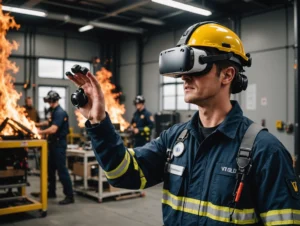
VR surrounds the user and reacts to his or her actions in a natural way, usually via head-mounted immersive screens.
Gesture recognition or handheld controllers track hands and body, and haptic (or tactile) feedback can be integrated.
Room-based systems provide a 3D experience while moving around large areas, or can be used with several participants...

Monitoring and evaluation should not be an afterthought, but central to your VR training strategy.
Immersive educational experiences are widely recognized for improving knowledge retention, as they give employees the opportunity to learn by doing and reinforce new skills by repeating tasks many times.
Employees who have used VR to learn also overwhelmingly believe they are better prepared for their jobs.
But tangible proof of the effectiveness of VR training is not just subjective and anecdotal. It's backed up by data and performance evaluations.
Performance data from VR training experiences can be easily recorded. Gesture tracking gives you an accurate assessment of an individual's ability and measurable evidence of the learning process.
By improving learning retention, employees are more likely to apply their new skills in the workplace, and ultimately have a positive impact on the company as a whole by improving their productivity.
In recent years, the refrain that young people leaving education lack the general skills required by employers has become a familiar one.
But with many companies disinvesting in graduate development, while remaining reliant on Covid-era home working, employers need work-ready recruits more than ever.
An innovative study of students from five vocational colleges, the published results show that 81 % of students recommend the experience to their peers.
Nearly 73 % were able to identify ways to improve their skills after the experience. 78 % of students found the experience effective in improving their skills.
According to an article in the Harvard Business Review, 59 % of hiring managers surveyed and 89 % of executives said they had difficulty finding employees with enough general practical skills.
An added challenge, especially when working remotely. So, after reading, listening to or watching instructions on how to improve their skills, learners will need opportunities to engage in deliberate practice.
Simply bringing learners together for a training course involves a great deal of planning and coordination, from scheduling time and reserving a suitable venue to organizing the necessary travel.
All this also generates additional costs.
Virtual reality (VR) training, like other forms of online training, eliminates many of the challenges associated with organizing a face-to-face workshop.
Many companies are now considering remote working as an option, even after the pandemic. The absence of physical proximity will make the skills required to build interpersonal relationships even more essential to retaining customers and employees.
Providing an immersive online training environment for remote workers is an excellent way of ensuring that they possess or can acquire the skills mentioned above.
They'll also learn other skills, such as conflict resolution and customer service in a realistic environment.

The most effective teaching methods using virtual reality are those in which the user's emotions are aroused.
Researchers have established a link between learning curves and the degree of presence, or involvement, of users during their experience.
Students who are not involved retain less information and are less prepared to apply the knowledge they possess to real-life situations. We're already familiar with these results from vocational education, which favors practice over theory.
VR simulations are enhanced to be interactive, so that users are more involved.
Immersive learning via virtual reality tools optimizes and maintains skill levels and enhances learning.
With the ability to transport students and trainees into real-life situations without any risk, science has shown that VR must be the way forward for educational establishments and industry alike.
The world needs experts who perform their roles to the highest standards. VR helps develop expertise.
VR can help to better train employees, reduce costs and lower overall corporate overheads. While an initial investment in VR technology is necessary, this is a long-term investment, and the technology can be used over and over again.
Companies and training organizations that get ahead of the curve and apply these cutting-edge technologies now will certainly be well ahead of the game. If you want to be one step ahead, discover the Fire Pro VR.