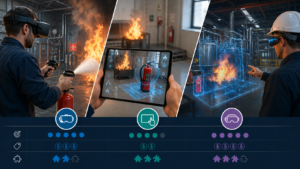
Traditionally, during fire training courses, trainees are required to handle fire extinguishers.
Traditionally, during fire training courses, trainees are required to handle fire extinguishers.
This phase familiarizes them with how each type of extinguisher works. It gives them a better understanding of the range and maximum duration of use of each type of extinguisher.
However, this training is not without consequences: not only is the cost of refilling extinguishers high, but the environmental footprint of extinguishers and the fire fumes created is significant.
Finally, the safety measures required for the use of fireplaces really limit the possible training scenarios.
What is mixed reality?
Mixed reality is a user environment in which physical reality and digital content are combined to enable interaction with and between real and virtual objects.
Unlike virtual reality (VR), which immerses the end user in an entirely digital environment, or augmented reality (AR), which superimposes digital content on a physical environment, mixed reality blends digital and real-world parameters.
Mixed reality is sometimes considered a type of augmented reality (AR), but its ability to interactively link real-world and digital elements places it further along the virtuality continuum.
This includes physical reality at one extreme and immersive virtual reality at the other.
Mixed reality is sometimes also called hybrid reality or extended reality (XR). A headset follows the user's gaze and maps the physical environment.
Software then uses deep learning algorithms to align digital content with specific areas of the map.
MR programming enables digital objects to interact with physical objects, and people to interact with digital objects as if they were physical.
So an ordinary desk can be transformed into an interactive computer touch screen, or an MR-generated movie character can sit on the owner's sofa.
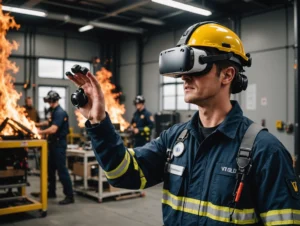
Although mixed reality is still in its infancy, it is already being used in many sectors for educational purposes. For example, aircraft manufacturers use MR as a cost-effective way of training repair technicians.
Instead of taking an engine out of an aircraft to conduct a training session, technicians wearing special helmets can see a holographic image of an engine.
Thus, they have gestures, glances and voice user interface (VUI) commands to interact with the hologram, change perspective and extract meaningful information, layer by layer.
Why fire scenarios?
Intrinsically, every real-life fire situation is unique. Environmental conditions are the driving force behind both types of fire start, growth and spread in the environment.
The presence of other flammable materials, other aggravating factors such as wind, smoke accumulations, etc. make each situation unique. The environment is therefore a key factor in the coherent simulation of fire outbreaks.
Faced with these challenges, one possible response is to integrate fire simulation into the real environment, using augmented reality (AR) technologies. This approach offers greater context and a wider range of learning scenarios.
Indeed, the trainer can easily choose all the parameters of the exercise, such as the type and location of fire sources, while taking into account the specificity of the real environment.
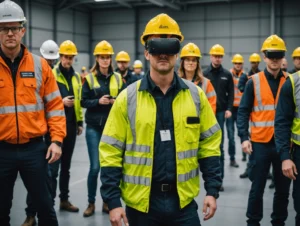
Such an approach can put trainees in a position representative of their usual working conditions, and confront them with situations relevant to their profession.
The aim of such simulations is to confront future firefighters, students, first-aiders, security guards and others with fire situations as realistically as possible, in order to prepare them as effectively as possible for such critical situations.
As stress management is a decisive factor in such disasters, preparation and rehearsal for certain high-risk situations can play a decisive role if the person is well prepared.
What's the added value of proposing fire scenarios?
The entire training environment is fully synthetic, making it possible to carry out scenarios that were previously impossible.
Large buildings, factories, shopping malls, ships, airports, oil refineries or drilling platforms can be represented with the utmost precision, or even custom-built from original plans on request.
All objects play an active role and can be realistically destroyed, emitting smoke, gas or steam.
Actual fire spread and extinction
The simulators use precise, custom-developed fire propagation models to guarantee a faithful representation of real-life situations.
Fully parametric, the user enters all the necessary information on an object's material properties, and the system calculates its behavior in real time.
Real fire-fighting equipment
One of the most advanced features of this type of system is that the active equipment used in the scenario, such as fire extinguishers, are modified with customized digital electronics.
What's more, they feature the same physical characteristics, controls, indicators and extinguishing capabilities, depending on type, as their real-life counterparts.
This means that trainees use equipment that is as close to the real thing as possible, and develop their muscle memory by instinctively executing the right actions the day they are confronted with a real incident.
High-fidelity sound
The simulators can reproduce the most realistic sounds of fire and destruction using immersive sound technologies, so the trainee can be disoriented or emotionally stressed to such an extent for maximum educational results.
After-action assessment
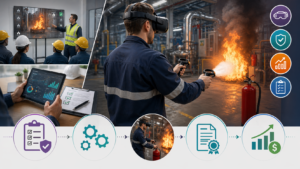
Some simulation programs offer assessments for trainees with a grading system on several subjects:
incident response time
correct selection of extinguishing media
correct positioning of hose or nozzle during fire-fighting operations
handle pressure time in relation to extinguisher capacity
Conclusion
Thanks to Fire Pro VR, you can now do your own fire training, and save on every aspect. Click here to find out how to get your hands on it.
The company
Since 2011, IMMERGENCE Studio has specialized in the development of real-time 3D applications and immersive tools.