VR Fire Training: The Complete Guide
Everything you need to know about immersive fire safety training with virtual and augmented reality.
Request a Free QuoteWhy VR Fire Training is the Future
VR fire training has become a mature solution used by over 300 companies in 22 countries. It replaces traditional fire drills with immersive simulations that are safer, cheaper, and more effective.
Real Extinguisher
FAST XR uses augmented fire extinguishers — real professional extinguishers compatible with virtual fire. The gesture is 100% transferable.
No need for a fire pan
No outdoor space, no fuel, no weather dependency. Train anywhere, anytime, in 40 minutes.
Cost Reduction 60-80%
From 49 EUR per session. No logistics, no external trainer required.
Unlimited Repetition
Each trainee can practice 50+ times versus 1-2 attempts with a fire pan. Repetition builds reflexes.
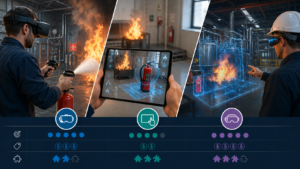
3 Technologies Available
| Technology | Environment | Fire extinguisher | Best For |
|---|---|---|---|
| Virtual Reality (VR) | 100% virtual | Virtual (controller) | Theory, complex scenarios |
| Augmented Reality (AR) | Real + virtual fire | Augmented | Practical experience on-site |
| Mixed Reality (MR) | Mixed reality | Augmented | Complete training |
FAST XR: The all-in-one solution
Used in 22 countries
FAST XR by Pro-XR is the only fire training simulator combining VR, AR and Mixed Reality with real augmented extinguishers (water, CO2, powder). Compatible with Meta Quest 3, 3S and Quest Pro. 4.8/5 satisfaction rating.
Related Articles
- Fire Safety VR Training: Comprehensive Guide (FR)
- Here's how to choose a fire simulator: **1. Define Your Needs:** * **Purpose:** What will you use the simulator for? (e.g., training firefighters, testing building designs, public safety demonstrations, research). * **Scale:** Do you need to simulate a small room fire, a building fire, or a wildfire? * **Realism:** How realistic do the flames, smoke, heat, and behaviour of the fire need to be? * **Interactivity:** Do you need to simulate different fire types, spread mechanisms, or suppression efforts? * **User Interface:** How easy does it need to be for users to operate and interact with the simulator? * **Data Output:** What kind of data do you need to collect from the simulation (e.g., temperature, smoke density, flame height)? **2. Types of Fire Simulators:** * **Physical Simulators:** These involve actual controlled fire. They are the most realistic but also the most expensive and require strict safety measures. Examples include burn buildings for firefighter training. * **Virtual Reality (VR) / Augmented Reality (AR) Simulators:** These use immersive technology to create realistic visual and auditory experiences of fire. They are excellent for training and can simulate dangerous scenarios safely. * **Computer-Based / Software Simulators:** These use mathematical models and algorithms to simulate fire behaviour. They can be very detailed and are useful for detailed analysis, design, and predictive modelling. They range from simple graphical representations to complex CFD (Computational Fluid Dynamics) models. * **Tabletop / Model Simulators:** Smaller-scale physical models that can demonstrate basic fire spread principles. **3. Key Features to Consider:** * **Accuracy of Fire Dynamics:** How well does the simulator model heat transfer, combustion, smoke production, and flame spread? * **Environmental Factors:** Can it simulate different ventilation conditions, building materials, and occupancy? * **Scenario Generation:** How easy is it to create and modify different fire scenarios? * **Visuals and Audio:** The quality of graphics and sound can significantly impact the user experience, especially for immersive simulators. * **Hardware Requirements (for software/VR):** What are the specifications for the computers or VR headsets needed? * **Customisation Options:** Can you tailor the simulator to your specific needs and training objectives? * **Reporting and Analysis Tools:** Does it provide tools to review and analyse the simulation results? * **Scalability:** Can the simulator handle different sizes and complexities of fire scenarios? **4. Budget and Cost:** * **Initial Purchase Price:** This varies greatly depending on the type and sophistication. * **Maintenance and Updates:** Consider ongoing costs for software updates, hardware maintenance, or consumables for physical simulators. * **Training:** Factor in the cost of training staff to operate and maintain the simulator. * **Installation and Setup:** Some simulators require significant setup. **5. Vendor and Support:** * **Reputation:** Research the vendor's track record and customer reviews. * **Technical Support:** What level of support is offered, and what are the response times? * **Training and Documentation:** Is comprehensive training and user documentation provided? * **Demonstration:** Request a demonstration of the simulator to see it in action before making a decision. **6. Ease of Use and Integration:** * **User-Friendliness:** Is the interface intuitive and easy for your intended users to learn and operate? * **Integration:** If it's a software simulator, can it integrate with other systems or data sources you use? By carefully considering these factors, you can select a fire simulator that best meets your specific requirements and provides effective results.
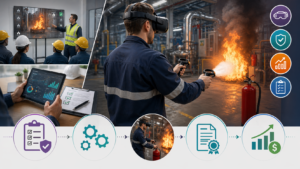
- ROI of VR fire training
- Request a quote
Ready to Transform Your Fire Training?
Over 300 companies trust FAST XR. Free personalised quote within 24 hours.
Request a Free Quote